
Perils for Pedestrians
TV talk about people who walk
Gallery of Railroad Right-of-Way Trails
Trails can be built along active rail lines as well as on abandoned rail lines. Only 1 percent of the 140,000 miles of railroads in the United States have a trail, so there is tremendous potential for additional rails with trails.
Railroad Right Of Ways often form the most direct and convenient route to a destination. Human nature being what it is, "No Trespassing" signs are not particularly effective at keeping people away if the ROW is the shortest route to a destination.
Safety does not require keeping people off of the entire ROW, it just requires keeping people off of the tracks. And since railroad ties and ballast are uncomfortable to walk on, providing a parallel trail will draw most people off of the tracks. A trail in a railroad ROW can often do more to keep people at a safe distance away from the tracks than posting "No Trespassing" signs.
Here are some examples of the many existing trails along active railroad ROWs. They look just like ped/bike trails you would find anywhere. For more information on pedestrian use of utility ROWs, see the Right of Way page.
Hallowell, Maine 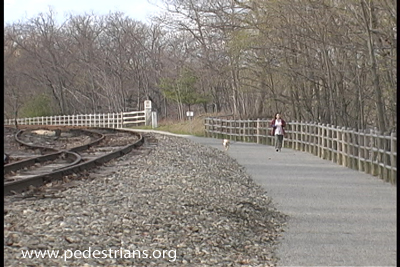
The Kennebec River Rail Trail runs between railroad tracks and the river from Augusta to Gardiner, ME.
Morristown, New Jersey 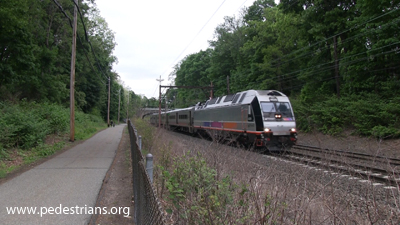
The Traction Line Trail runs next to New Jersey Transit trains in Morristown
and Morris Township, New Jersey. It uses the old roadbed of the Morris
County Traction Company, which abandoned trolley service in the 1920s.
Minneapolis, Minnesota 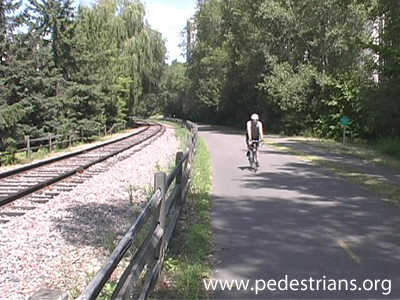
The Burnham Rail-With-Trail forms part of the trail network in Minneapolis. Bicyclists, pedestrians, and trains share a green corridor through the urban area.
Albion, Rhode Island
The Blackstone River Bikeway parallels railroad tracks for six miles
along the Blackstone River. It's a key link in a route that will go from
Providence, RI, to Worcester, MA.
Frostburg, Maryland
The eastern end of The Great Allegheny Passage trail follows a rail line from Frostburg to Cumberland, MD. The trail and track have to share the 914-foot Brush Tunnel, but it was originally build for two tracks so there is room for both.
Northern Georgia 
The Silver Comet Trail runs for 61.5 miles from the Atlanta region to the Alabama border. It is a mixture of Rails To Trails and Rails With Trails.
(Photograph courtesy Hagen Hammons)
Newark, Ohio 
The T.J. Evans Panhandle Recreational Trail runs next to railroad tracks for 10 miles.
(Photograph courtesy Judy Floy)
Denver, Colorado 
A trail runs along the South Platte River and a rail line.
(Photograph courtesy George Berger, AICP)
Salem, Oregon 
A service road was converted to a shared-space pedestrian facility next to railroad tracks in Salem. A low fence guides pedestrians to the frequent grade crossings every block at side streets.
York, Pennsylvania
A group of seniors ride the Heritage Rail Trail.
Photograph courtesy York County Rail Trail Authority.
Portland, Oregon 
The Springwater Corridor Trail follows a rail line in Portland, Oregon. The Portland trail system uses many types of ROWs to create a network.
Railroad Bridges
Active railroad bridges are particularly dangerous places. If a train should come along while someone is on the bridge, they can be trapped, with tragic consequences. Which is why providing safe pedestrian alternatives to railroad tracks on bridges is so important.
Cologne, Germany 
The busiest railroad bridge in Germany, the Hohenzollern Bridge over the Rhine River was built with wide pedestrian paths on both sides.
Harpers Ferry, West Virginia 
This old railroad bridge had two tracks, but only one was still needed. The other half of the bridge was converted to trail use, connecting West Virginia with Maryland and carrying the Appalachian Trail over the Potomac River.
Portland, Oregon 
There wasn't any extra room by the railroad tracks on the lower level of the Steel Bridge, so a path was cantilevered off the side. The bridge forms a key link between the river front trails on the two sides of the Willamette River.
Memphis, Tennessee
The Big River Crossing was built on the structure for the old carriageway
on the Union Pacific Railroad Bridge over the Mississippi River.
Vicksburg, Mississippi 
The Old Vicksburg Bridge across the Mississippi River was built in 1930 to carry both a railroad and a roadway over the river. After the I-20 bridge was built, the old bridge was closed to automobile traffic in 1998. Efforts to open the bridge for pedestrian traffic have met strong opposition from the Kansas City Southern Railroad, citing safety concerns.
The nearest alternatives for pedestrians and bicyclists to cross the Mississippi are 70 miles downstream in Natchez, MS, or 86 miles upstream in Greenville, MS. The only choices pedestrians in Vicksburg have are to walk on the I-20 bridge or walk on the Old Vicksburg Bridge. But since the roadway entrance to the bridge is fenced off, pedestrians using the old bridge get to it by walking down the railroad tracks.
Kansas City Southern does not seem to understand that their opposition
to pedestrians using the old roadway because of unfounded "safety
concerns" is leading pedestrians to do something genuinely unsafe,
namely walk on the railroad tracks across the bridge.
More on Right of Way Trails.